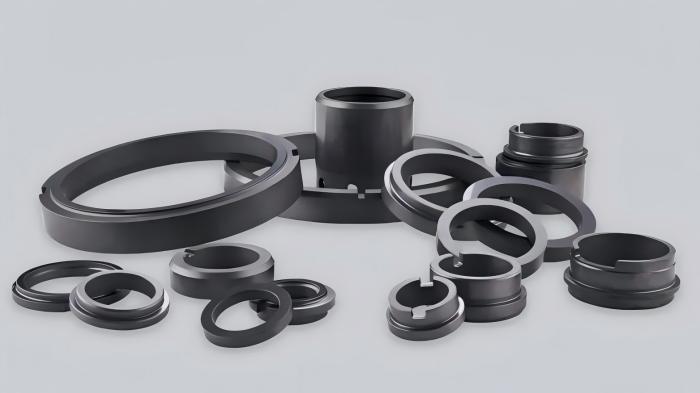
A pumping ring is a critical rotating component inside a mechanical seal that circulates barrier or buffer fluid around the seal faces. By creating forced fluid flow, it cools and lubricates the sealing interface, removes frictional heat, and prevents seal failure – making it essential for reliable pump operation in high-temperature, high-pressure and harsh industrial environments.
Often described as a “mini impeller” for the seal chamber, the pumping ring is one of the most underrated but important parts of a mechanical seal system. This guide explains how it works, the different types available, and how to select the right one for your application.
Key Takeaways
- Pumping rings circulate barrier fluid to cool and lubricate mechanical seal faces
- They are required for API Plan 23 and Plan 53A dual seal configurations
- Three main designs: rectangular slot, crescent pocket and spiral groove
- Proper selection extends seal life from months to decades
- Consider fluid viscosity, temperature, pressure and pump speed when choosing a design
How a Pumping Ring Works
Basic Operating Principle
The pumping ring is mounted on the pump shaft and rotates with it. As it spins, its specially designed grooves or pockets create a centrifugal pumping action that drives fluid around the seal chamber in a continuous loop.
This forced circulation:
- Carries frictional heat away from the seal faces
- Maintains a consistent lubricating film between the rotating and stationary faces
- Prevents localized overheating that can cause seal face cracking or blistering
- Removes any debris or particles from the sealing area
Critical API Standard Applications
Pumping rings are mandatory components in two of the most common industrial seal plans:
- API Plan 23: The pumping ring recirculates process fluid from the seal chamber through an external cooler and back to the seal. This is the most widely used plan for hot water and hydrocarbon pumps.
- API Plan 53A: The pumping ring circulates clean barrier fluid between the inboard and outboard seals of a dual seal configuration, providing both lubrication and leak containment.
Why Pumping Rings Are Critical
Mechanical seals generate significant heat from friction between the rotating and stationary faces. Without proper cooling, seal temperatures can exceed 500°F (260°C), leading to:
- Premature wear of seal faces
- Cracking or blistering of carbon components
- Seal leakage and process fluid loss
- Unplanned downtime and expensive repairs
A properly designed pumping ring reduces seal face temperatures by 50-70%, extending average seal life from 12-18 months to 5-10 years or more.
Common Types of Pumping Rings
There are three main types of pumping rings, each optimized for different operating conditions:
| Type | Design Features | Best For |
|---|---|---|
| Rectangular Slot | Simple straight slots cut into the ring | Low to medium speed pumps, thin liquids (water, solvents) |
| Crescent Pocket | Curved, crescent-shaped pockets | Medium speed pumps, medium viscosity liquids (oils, hydrocarbons) |
| Spiral Groove | Continuous spiral grooves acting as a mini impeller | High speed pumps, high viscosity liquids, compressors |
Rectangular Slot Design
The simplest and most economical design. Straight slots create basic fluid movement and work well for general-purpose applications. Easy to manufacture and maintain.
Crescent Pocket Design
Curved pockets provide smoother, more efficient fluid flow with less turbulence. Ideal for medium-duty applications and fluids that are sensitive to shear.
Spiral Groove Design
The most efficient design, capable of generating higher flow rates and pressures. Excellent for high-speed pumps and challenging applications where effective cooling is critical.
How to Select the Right Pumping Ring
Key Selection Criteria
- Fluid Properties: Viscosity, temperature, chemical compatibility and presence of solids
- Operating Conditions: Pump speed, pressure and temperature
- Seal Configuration: Single vs dual seal, API plan type
- Clearance Requirements: Proper radial and axial clearances are critical for optimal performance
Temperature-Specific Guidelines
- Below 200°F (93°C): Standard clearances and materials are sufficient
- 200-500°F (93-260°C): Use high-temperature materials (316 stainless steel, Hastelloy)
- Above 500°F (260°C): Increase diametral clearances by 0.005″ (125 µm) to account for thermal expansion
Material Options
- 316 Stainless Steel: Standard for most general-purpose applications
- Hastelloy C: For corrosive chemicals and high-temperature applications
- Titanium: For highly corrosive environments like seawater and acid solutions
Conclusion
The pumping ring is a small but critical component that plays a vital role in the reliability and longevity of mechanical seals. Proper selection and maintenance of this component can significantly reduce downtime and maintenance costs in industrial pumping systems.
For high-quality, custom-engineered pumping rings designed for the most demanding industrial applications, trust Victor. Our pumping rings are manufactured from premium materials to exacting standards, ensuring optimal performance and extended seal life in even the harshest environments. Contact our engineering team today to discuss your specific application requirements.
FAQ
What does a pumping ring do in a mechanical seal?
A pumping ring circulates barrier or buffer fluid around the seal faces to provide cooling and lubrication. This prevents overheating and extends the life of the mechanical seal.
How does a pumping ring extend seal life?
By maintaining proper cooling and lubrication, a pumping ring reduces frictional wear and prevents thermal damage to the seal faces. This can increase seal life by 3-10 times compared to seals without effective circulation.
Can all pumps use the same type of pumping ring?
No. The correct pumping ring design depends on the pump’s speed, the fluid’s viscosity and the operating temperature. Using the wrong design will result in poor cooling and premature seal failure.
What are the signs of a worn pumping ring?
Common signs include increased seal temperature, higher leakage rates, unusual noise from the seal chamber and reduced seal life. Pumping rings should be inspected and replaced whenever the mechanical seal is serviced.
How often should a pumping ring be replaced?
Pumping rings should be replaced every time the mechanical seal is rebuilt, typically every 3-5 years depending on operating conditions.