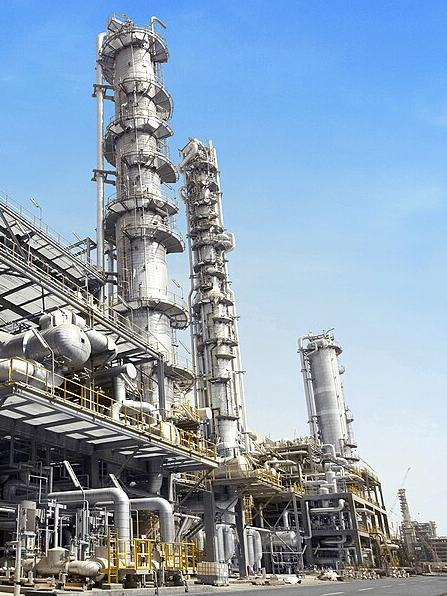
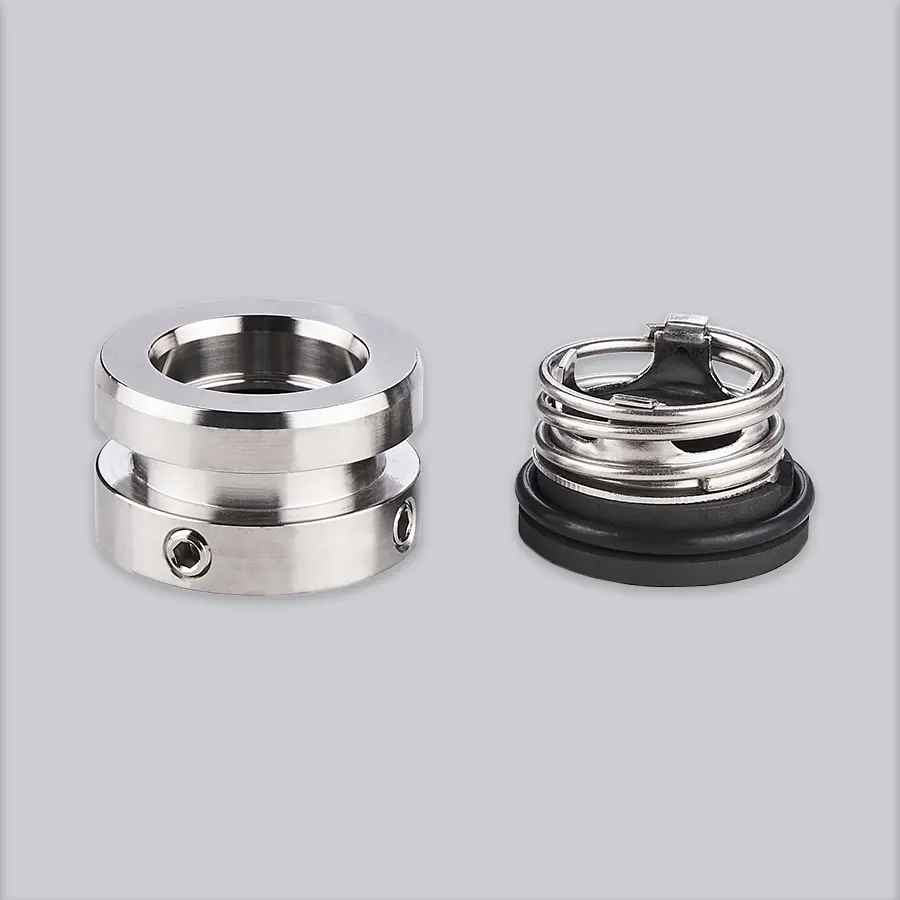
A mechanical seal forms a zero-leak barrier between rotating pump shafts and stationary pump housings, relying on a complete set of matched components to contain process fluid. Its core assembly includes primary sealing faces, secondary elastomer seals, spring or bellows loading units, and supporting hardware including sleeves, glands and retainers. Each component carries an independent function and must coordinate closely to prevent leakage and extend pump service life.
Key Takeaways
- Primary rotating & stationary sealing faces form the core leakage-blocking interface of a mechanical seal
- Springs or bellows maintain consistent contact between sealing faces to compensate for wear and shaft movement
- Secondary seals (O-rings, gaskets) fill tiny gaps around ring assemblies to eliminate auxiliary leakage
- Support hardware (gland plate, shaft sleeve, retainer) protects the pump shaft and locks the whole seal assembly in alignment
- Proper material selection matching fluid chemical, temperature and pressure conditions is the key to long seal lifespan
Full Breakdown of Mechanical Seal Components
1. Primary Sealing Faces (Main Sealing Interface)
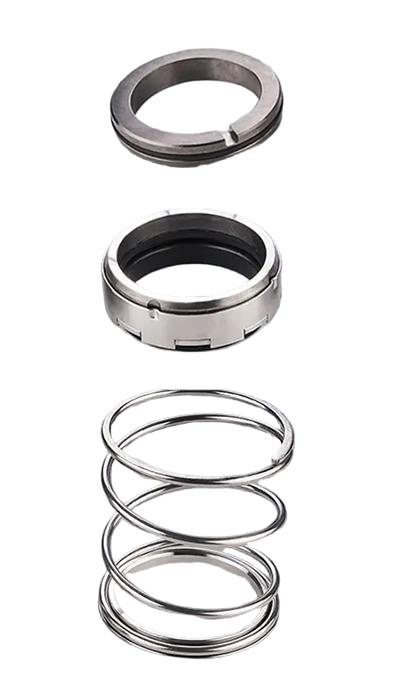
This is the critical friction pair that stops main fluid leakage, split into two matching parts:
- Rotating primary ring: Mounted on the shaft and rotates synchronously with equipment. Usually made of carbon graphite (good self-lubrication) or tungsten carbide (high abrasion resistance for slurry media). Its ultra-flat smooth surface contacts the stationary ring tightly to form a liquid film for lubrication.
- Stationary mating ring (seat): Fixed inside the pump gland, static during operation. It matches the rotating ring to build the primary sealing plane, with an auxiliary secondary seal fitted around its outer edge to prevent bypass leakage.
2. Secondary Seals
Secondary seals are elastomer O-rings, PTFE gaskets and flexible packing, responsible for sealing gaps around primary rings. Two mainstream structures are widely used:
- Pusher type: Secondary O-rings slide along the shaft, suitable for medium-to-high pressure working conditions.
- Non-pusher bellows type: Integrated metal or rubber bellows replace sliding O-rings, ideal for high temperature and corrosive chemical fluids.
3. Loading Parts: Springs & Bellows
Springs or bellows provide constant axial pressure to keep the two sealing faces tightly fitted, offsetting minor shaft deflection, thermal expansion and gradual face wear.
- Single large spring: Simple structure, anti-corrosion, fit medium-size shafts.
- Multiple small springs: Uniform pressure distribution, compact size for narrow installation spaces.
- Bellows assembly: Flexible axial compensation, no sliding friction, perfect for high-temperature harsh media.
4. Supporting Hardware Assembly
All auxiliary metal parts fix and protect the seal assembly, ensuring long-term alignment and avoiding shaft damage.
Gland Plate
Mounted on the pump casing to clamp the stationary ring assembly, locking the static sealing part in position and maintaining parallelism of sealing faces under pressure fluctuation.
Shaft Sleeve
A protective bushing sleeved on the pump shaft. It isolates the raw shaft from abrasive, corrosive process fluid to avoid scoring and corrosion damage, and provides a smooth running surface for secondary seals.
| Core Benefit | Description |
|---|---|
| Anti-scratch protection | Separates shaft from abrasive solid particles in fluid |
| Corrosion isolation | Resists chemical erosion in chemical processing pumps |
| Extend seal life | Delivers smooth surface to reduce secondary seal wear |
Retainer & Set Screws
Lock the rotating ring assembly firmly onto the shaft sleeve via set screws to prevent circumferential slipping and axial displacement during high-speed rotation. Always fasten set screws tightly before pump startup to avoid early seal failure.
How All Mechanical Seal Parts Work Together
- Sealing barrier formation: Rotating and stationary faces are pressed together by spring force to form a thin lubricating liquid film, cutting off main fluid leakage.
- Auxiliary leakage blocking: Secondary elastomer seals fill gaps between rings, sleeves and glands to eliminate bypass seepage.
- Dynamic compensation: Springs/bellows absorb shaft deflection, thermal expansion and face wear to keep faces fully attached.
- Structural protection: Gland plates and shaft sleeves maintain overall alignment and shield the pump shaft from medium damage.
Three core factors determine stable sealing performance: balanced hydraulic pressure on faces, precise axial alignment, and effective vibration suppression. Any misalignment or loose hardware will cause rapid face wear and medium leakage.
How to Select Matching Seal Components
Material Matching Rules
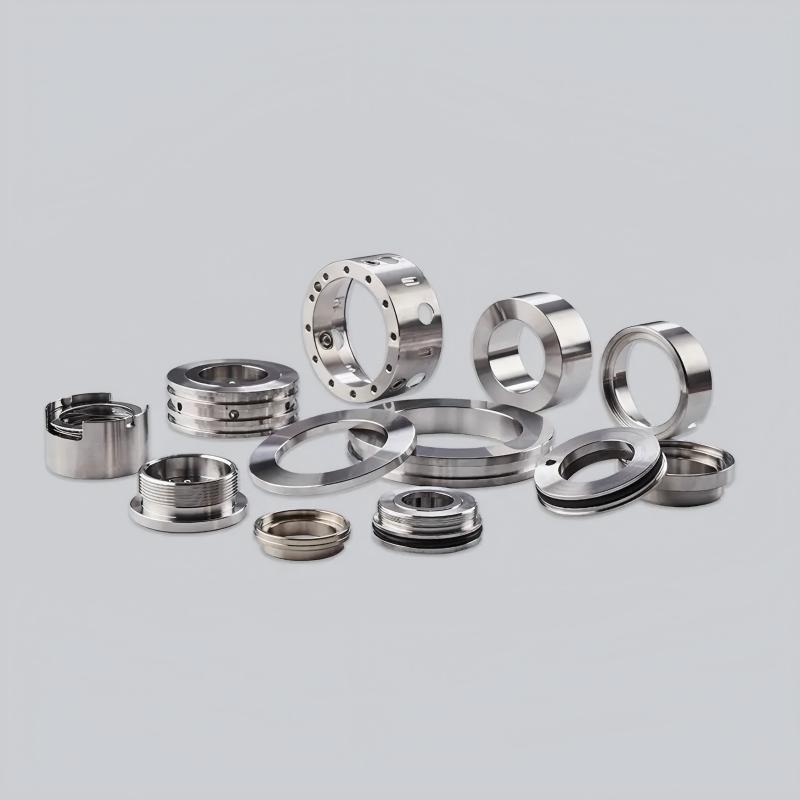
Component materials must match working fluid properties, operating temperature and pressure, with industry standards like API 682 as reference. Key judging factors:
- Fluid chemical corrosion resistance
- Max continuous operating temperature & pressure
- Fluid viscosity and solid particle content
- Cost and long-term maintenance cycle
Common standard materials: carbon graphite, tungsten carbide, silicon carbide, fluorine rubber, PTFE, stainless steel.
Application Condition Matching
Different working environments require corresponding structural combinations of seal parts:
| Working Condition | Impact on Component Selection |
|---|---|
| High temperature | Choose high-temperature resistant bellows & fluorine secondary seals |
| High pressure | Adopt multi-spring loading & hard alloy sealing faces |
| Strong corrosive fluid | Select 316 stainless steel hardware + PTFE gaskets |
For extreme working conditions (ultra-high temp, strong acid slurry, vacuum), custom mechanical seal assemblies with special alloy faces and customized bellows structures are available.
Conclusion
Every component of a mechanical seal performs an irreplaceable role, and coordinated operation of primary faces, secondary seals, loading springs and supporting hardware determines sealing stability and service life. Reasonable material selection and standardized installation can drastically lower leakage rates and reduce pump maintenance downtime.
If you need standard or custom mechanical seal assemblies matched to your pump models and working mediums, Victor supplies complete series of mechanical seals with full material options for chemical, water treatment, food and petroleum industrial equipment. Contact our engineering team for professional component matching solutions.
FAQ
What is the core function of a mechanical seal on pumps?
It creates a leak-proof barrier between the rotating shaft and static pump housing, preventing process fluid leakage, reducing safety hazards and cutting medium waste.
What causes mechanical seal failure in most cases?
Misaligned installation, insufficient spring preload, incompatible materials with process fluid, excessive vibration, and lack of lubrication between sealing faces are the top failure causes. Regular inspection can spot early wear and avoid unexpected pump shutdown.
How often should mechanical seals be inspected?
Inspect during routine equipment maintenance; check for fluid seepage, abnormal vibration and face wear. Timely replacement of aging secondary O-rings can greatly extend overall seal service life.
Can mechanical seals be customized for special industrial scenarios?
Yes. Manufacturers can customize sealing face materials, spring structures, sleeve sizes and gland configurations for high-temperature, high-pressure, corrosive and slurry mediums to match unique pump operating requirements.