Seal failure can cost industrial plants thousands of dollars through unplanned downtime, product leakage, and safety risks. Choosing the wrong seal material can also lead to premature wear, chemical attack, or unexpected process shutdowns.
The short answer: choose seal face materials based on abrasiveness, temperature, and operating conditions, and select elastomers based on fluid chemistry, pH, and temperature. Because every component must work together, the seal faces, elastomer, and metal hardware all need to be compatible with the process fluid.
This guide compares common mechanical seal materials and explains how to select the right combination for different chemicals and operating conditions.
Key Takeaways
- Start by fully defining your process fluid: chemical composition, concentration, pH, temperature and solids content — including cleaning and upset conditions, not just normal operation.
- For faces: silicon carbide for high heat and fine abrasives; tungsten carbide for heavy slurry and impact loads; carbon graphite for clean, lubricated service.
- For elastomers: EPDM for water, steam and high pH; FKM for hydrocarbons and most acids; FFKM for extreme chemical and thermal conditions.
- Always balance upfront cost against service life and downtime risk. The right material choice reduces seal-related downtime by 40–60% in most tough applications.
Key Factors in Mechanical Seal Material Selection
Chemical Compatibility and pH
Chemical compatibility is the first and most important filter. Always evaluate the most aggressive condition the seal will see — typically cleaning cycles, startup transients or upset conditions, not steady-state normal operation. A seal that works fine in routine service can fail rapidly during a brief chemical spike.
pH provides a quick initial screening:
- Neutral pH (~7): NBR or FKM for general service
- High pH (>12, strong caustics): EPDM or FFKM with silicon carbide faces
- Low pH (<2, strong acids): FKM or FFKM with silicon carbide faces
The elastomer component is almost always the first part to fail in chemical service. Secondary seals degrade from chemical attack before harder face materials show visible damage.
Temperature
Temperature accelerates chemical attack — reaction rates roughly double for every 10°C (18°F) rise in process temperature. Always use the maximum operating temperature, not the average, for material selection.
Temperature also limits face material performance, especially when the face is mounted in different body materials. For example, a silicon carbide ring pressed into a 316 stainless steel body has a much lower temperature limit than the same ring in an Alloy 42 body, due to differential thermal expansion.
Pressure
Higher pressure increases face loading, accelerates wear and introduces specific failure modes:
- Face fracture or chipping in hard, brittle materials
- Elastomer extrusion into clearances
- Uneven face loading and leakage paths
Pressure ratings always go hand-in-hand with temperature ratings. Higher temperatures reduce effective pressure capability for all materials.
Abrasiveness and Solids Content
Fluid abrasiveness is the biggest driver of face material wear.
- Fine, light abrasives + corrosive fluids → silicon carbide (superior wear resistance and heat dissipation)
- Heavy slurry, large solids, high vibration → tungsten carbide (superior fracture toughness and impact resistance)
- Clean, particle-free fluids → carbon graphite or ceramic (cost-effective)
Wear patterns tell you if you have the wrong material: uniform fine scoring is normal; deep, grooved wear like a gramophone record indicates abrasive service with a face material that is too soft.
Shaft Speed
Higher shaft speed increases frictional heat at the seal faces and raises PV (pressure-velocity) loading. Above ~3,600 rpm, frictional heat becomes a major factor in material selection and may require cooling or hydrodynamic lift features.
Mechanical Seal Material Selection for Common Industrial Fluids
| Fluid | Recommended Face Material | Recommended Elastomer | Notes |
|---|---|---|---|
| Clean water / wastewater | Silicon carbide / carbon | EPDM | Ceramic faces acceptable for clean cold water; avoid carbon in gritty service |
| Strong acids (sulfuric, hydrochloric) | Silicon carbide | FKM / FFKM | Avoid tungsten carbide — acid attacks the binder |
| Strong caustics (sodium hydroxide) | Silicon carbide | EPDM / FFKM | Use FFKM above 150°C |
| Crude oil / petroleum | Tungsten carbide / carbon | NBR / FKM | FKM for higher temperatures |
| Slurry / mining tailings | Tungsten carbide | FKM / EPDM | WC resists impact from large solids |
| Solvents / organic chemicals | Silicon carbide | FKM / FFKM | FFKM for aggressive solvent blends |
| Steam / hot water | Silicon carbide | EPDM / FFKM | Avoid FKM in continuous steam service |
| CIP cleaning systems | Silicon carbide | EPDM / FFKM | Avoid ceramic — thermal shock causes cracking |
Mechanical Seal Material Selection Process
Follow this systematic method to eliminate mis-selection:
Step 1: Fully define the process fluid
Document chemical composition, concentration, pH, solids content, viscosity and vapor pressure. Include all fluids the seal will contact: process fluid, flush media, barrier fluids and cleaning chemicals. The most aggressive fluid sets the material requirement.
Step 2: Map operating limits
Calculate maximum and minimum temperature, pressure and shaft speed. Determine the PV factor for the seal size and operating conditions. Identify any transient conditions: startup, shutdown, pressure spikes, thermal cycles.
Step 3: Select face material
Choose based primarily on abrasiveness, temperature and chemical compatibility.
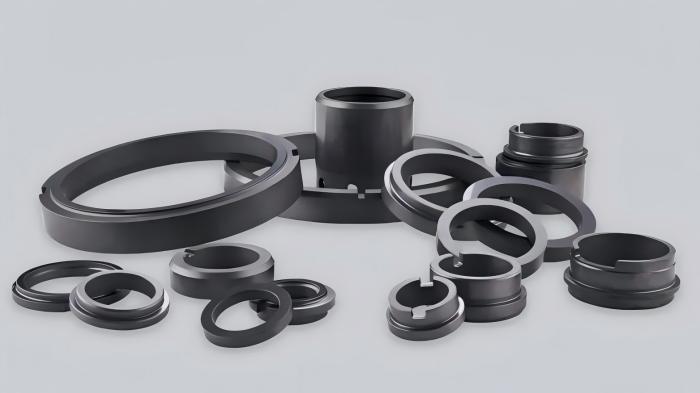
- Clean, low abrasion → carbon graphite or ceramic (budget)
- General chemical / moderate abrasion → silicon carbide (standard)
- Heavy slurry / high vibration → tungsten carbide (heavy duty)
Step 4: Select elastomer material
Choose based on fluid chemistry and maximum temperature.
- General water service → EPDM
- Oil / hydrocarbon service → NBR (low temp) / FKM (high temp)
- Aggressive chemicals / high heat → FFKM
Step 5: Verify all components
Check compatibility of every component: face, elastomer, springs, metal hardware and O-rings. A seal is only as strong as its weakest part. Recheck compatibility whenever process fluids change.
Pro tip:Always check a mechanical seal manufacturer‘s compatibility data, especially for mixed chemical systems. For OEM pumps, match the original seal code (e.g., Grundfos HQQE = SiC faces + EPDM elastomer) or upgrade materials for tougher service.
Conclusion
Material selection is the single biggest factor in mechanical seal reliability and service life. The most common cause of premature seal failure is mismatched material to process conditions, not manufacturing defect.
Take the time to fully define your fluid and operating conditions before selecting materials. Use the comparison charts as a starting point, then verify final selection with a seal manufacturer or compatibility database, especially for mixed or aggressive chemical services.
The right upfront material choice will almost always pay for itself many times over in reduced downtime, fewer replacements and lower total cost of ownership.
FAQ
Which mechanical seal material works best for highly corrosive chemicals?
Silicon carbide faces offer excellent resistance to most acids and caustics, typically paired with EPDM for high-pH service or FKM/FFKM for acidic and solvent service. Ceramic faces are a lower-cost option for milder corrosive fluids. Always verify compatibility at your exact concentration and temperature.
How does silicon carbide compare to tungsten carbide for abrasive fluids?
Silicon carbide has higher hardness and better thermal conductivity, so it wears better in fine-particle abrasive fluids and high-temperature service. Tungsten carbide has higher fracture toughness, so it handles large solids, heavy impact and high vibration better without chipping. For heavy slurry pumps with large suspended solids, tungsten carbide is usually the better choice.
What elastomer is best for high-pH applications?
EPDM handles a pH range of 0–14 and is the best choice for most caustic solutions, water and steam service. FKM performs poorly in strong caustics and will fail prematurely. For temperatures above 150°C, upgrade to FFKM for extended life.
Can custom mechanical seals match OEM pump specifications?
Yes. Experienced seal manufacturers like Victor produce OEM-equivalent and upgraded-material seals for most major pump brands including Grundfos, Flygt and Alfa Laval. They match original dimensions and can upgrade material specifications for tougher service, without modification to the pump itself.